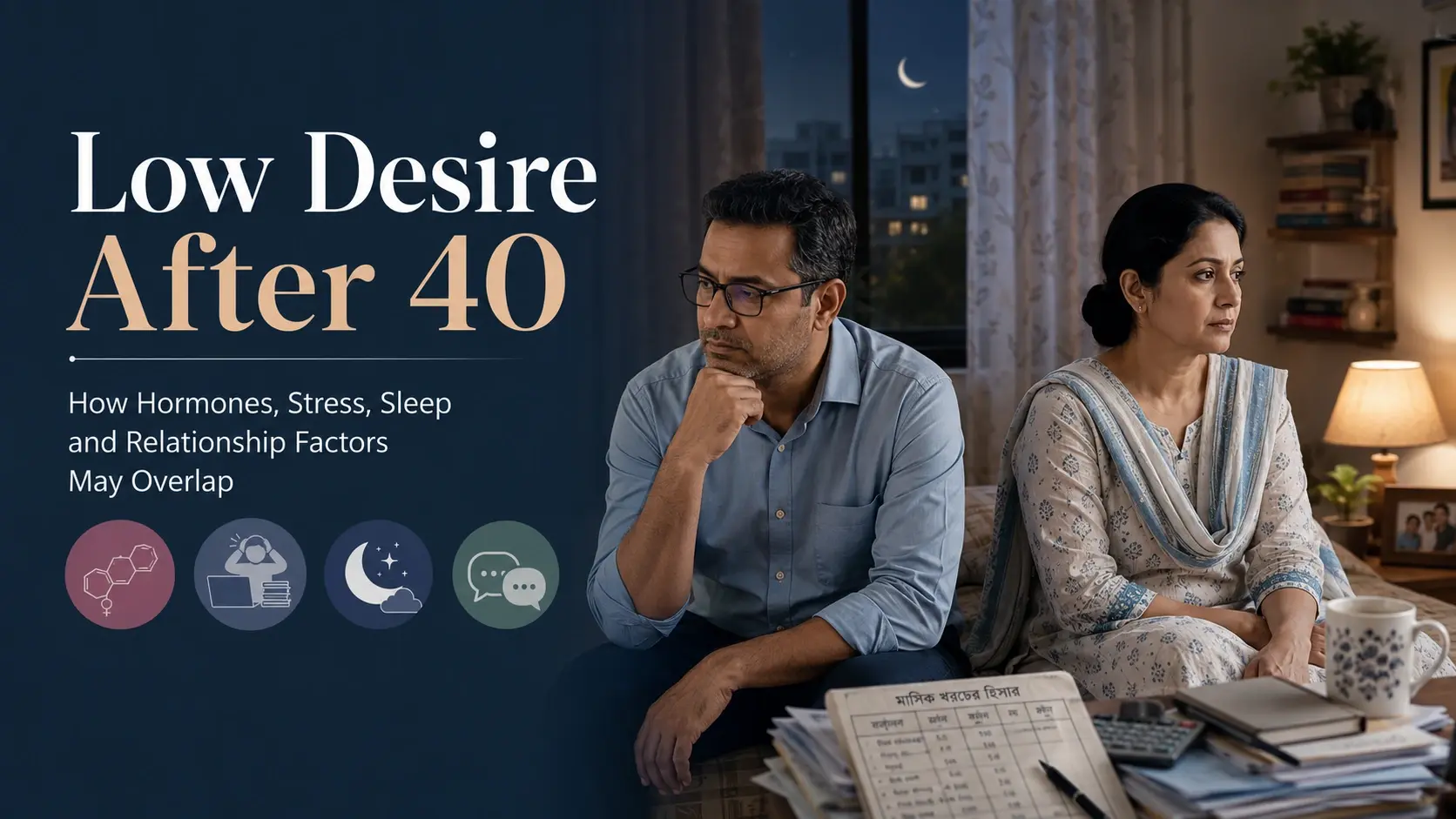
Low Desire After 40: How Hormones, Stress, Sleep and Relationship Factors May Overlap
Desire rarely changes for one neat reason. After 40, someone may notice that interest in intimacy is lower, less predictable, or easier to lose when life becomes demanding. The first explanation may be age, hormones, or a relationship problem—but those conclusions are often premature.
Health, sleep, medicine, emotional strain, physical comfort, privacy and long-term relationship dynamics can all shape desire. For many Bangladeshi adults, the picture also includes long working hours, financial responsibilities, parenting, caring for older relatives and limited private time at home.
Low desire after 40 is therefore better understood as a pattern to explore, not a verdict about the person or the relationship. This adult-focused article explains how the different influences may overlap, what deserves attention and when a qualified professional should become part of the conversation.
Age Tells You When the Change Happened; Not Necessarily Why
Sexual desire naturally varies across adult life. It can change with health, energy, mood, circumstances and relationship context. There is no single “correct” level of desire that every adult should maintain.
The years after 40 often bring several changes at once. A person may begin taking medicine for diabetes or high blood pressure, sleep less because of family responsibilities, enter perimenopause, recover more slowly from illness or carry heavier financial pressure. The change in desire may become noticeable during this stage without age being its only cause.
The NHS guidance on loss of libido identifies a broad range of possible influences, including stress, relationship difficulties, anxiety, depression, menopause, certain medicines, diabetes, heart disease and an underactive thyroid.
A brief change during illness, exhaustion or a difficult month may settle as the situation improves. A pattern that continues, worsens or causes distress deserves more careful attention.
Start With the Timeline, not a Theory
Online discussions tend to jump straight to hormones, attraction or relationship failure. That is a poor way to investigate a complex change.
A more useful starting point is the timeline. Consider what changed around the same period:
| Pattern noticed | Area worth discussing | What it does not prove |
|---|---|---|
| Desire changed after starting or adjusting medicine | Possible medicine effect | That the medicine should be stopped |
| Poor sleep and daytime exhaustion appeared together | Sleep quality, workload or a sleep condition | That sleep is the only cause |
| Menstrual changes, disturbed sleep or hot flushes appeared | Perimenopause or menopause assessment | That every symptom is hormonal |
| Lower interest came with discomfort or erection difficulties | Physical health, circulation, hormones or pain | Relationship failure |
| The change followed prolonged anxiety or low mood | Mental and emotional wellbeing | That the concern is imaginary |
| Pressure, conflict or lack of privacy increased | Relationship comfort and emotional safety | That one partner is solely responsible |
| Diabetes, thyroid or cardiovascular concerns are present | General health and medicine review | A diagnosis based on low desire |
This table is not a diagnostic test. Its purpose is to help organise information before a professional consultation.
Useful details include when the change began, whether it is constant or situational, whether sleep or stress changed, whether discomfort is present and whether any medicine was recently introduced or adjusted. A clear timeline gives a clinician something more useful than a vague statement that desire feels “different.”
Hormones Belong in the Picture, but Not at the Centre by Default
Hormones matter, but the internet has turned “hormonal imbalance” into a lazy explanation for almost every midlife concern.
For women, perimenopause and menopause may involve hormonal and physical changes. Disturbed sleep, hot flushes, mood changes or discomfort may influence interest in intimacy. The Mayo Clinic’s menopause guidance explains that menopause-related symptoms can affect sleep, energy and mood.
That connection is important, but it does not mean menopause explains every change in desire. Work pressure, medicine, relationship strain, diabetes, thyroid health, pain and emotional wellbeing may be involved at the same time. Readers needing more focused information can visit Menopause and Intimacy.
For men, lower desire is frequently blamed on testosterone without proper assessment. Testosterone-related conditions are real, but low interest, reduced energy and mood changes have several possible explanations. The Endocrine Society’s 2026 statement on testosterone replacement therapy states that symptoms alone do not diagnose hypogonadism.
A qualified professional may recommend hormone testing when the wider health history supports it. Random testing, online symptom quizzes and unverified “hormone boosters” cannot replace that assessment.
Further educational information is available in the Hormonal Health Conditions section.
The Quiet Effect of Poor Sleep and a Crowded Mind
A person can care deeply about a spouse and still have little mental or physical energy left for intimacy.
The National Heart, Lung, and Blood Institute explains that sleep deficiency can cause daytime tiredness and interfere with normal functioning. Sleep problems may also sit beside irritability, low energy, health anxiety, pain or menopause symptoms.
In Bangladesh, exhaustion is not always caused by one obvious event. It may build through long working days, traffic, financial worries, children’s education, household responsibilities or caring for an older parent. In a crowded home, limited privacy may create another practical barrier.
Stress does not work like an on-and-off switch. Telling someone to “just relax” is dismissive and rarely useful. Instead, notice whether desire changes during periods of better rest, lower pressure or greater privacy.
Sleep should not be blamed for everything either. Severe daytime fatigue, persistent insomnia, loud snoring with interrupted breathing or continuing exhaustion may deserve a proper health assessment.
Health Conditions and Medicines Deserve a Proper Review
Sexual wellbeing is part of general health. Diabetes, cardiovascular disease, thyroid conditions, chronic pain, neurological conditions, anxiety, depression and other illnesses may affect energy, comfort, mood, blood flow, nerve function or confidence.
Diabetes is especially relevant because it can affect nerves and blood vessels. The US National Institute of Diabetes and Digestive and Kidney Diseases explains that diabetes may be associated with changes in desire and response, reduced blood flow, nerve changes, hormonal factors and physical discomfort. It also warns that other conditions can cause similar concerns. See the NIDDK guidance on diabetes and sexual problems.
The separate Beshi Khushi guide to diabetes, heart health and sexual wellness after 40 covers that medical overlap in more detail.
Physical discomfort or recurring erectile difficulties can also make a person less interested in intimacy. That does not make low desire and erectile dysfunction the same condition. Adults noticing repeated erection problems can read Erectile Dysfunction After 40.
Some antidepressants, blood-pressure medicines and other prescriptions may affect sexual function in certain people. The underlying illness may also contribute, so blaming the medicine without a review can lead to the wrong conclusion.
Never stop, reduce or replace prescribed medicine based on an article or social-media post. A doctor or pharmacist can examine the timing, medicine history, other symptoms and possible clinical options safely.
Lower Desire Is Not a Relationship Verdict
A change in desire is easy to misread. One person may feel rejected, while the other feels pressured or ashamed. Neither interpretation necessarily reflects what is actually happening.
Affection, loyalty and emotional commitment can remain strong while desire is affected by exhaustion, discomfort, health concerns, unresolved tension or lack of privacy. Partners may also have different levels of interest without either person being uncaring or defective.
The situation usually becomes harder when a partner responds with guilt, repeated demands, ridicule, comparison or silence used as punishment. Pressure does not create emotional safety.
A calmer opening might sound like this:
“I have noticed that my interest has changed. I do not want to blame either of us. Could we look at whether stress, sleep, health, comfort or pressure may be involved?”
This is an example, not a therapy script. Real conversations should sound natural and remain voluntary. Neither person should be forced into intimacy, medical testing or emotional disclosure.
When conversations repeatedly become hostile, humiliating or controlling, a qualified relationship counsellor or mental-health professional may help establish safer communication.
Seeking Help Privately in Bangladesh
Many adults in Bangladesh avoid discussing low desire because they expect judgment or worry that personal information will not remain private. Those concerns are real, but silence should not become medical neglect.
An adult can request a private consultation with a qualified doctor and ask how personal information will be handled. The conversation can begin in simple health language:
“My level of sexual desire has changed. Could sleep, stress, hormones, medicine or another health condition be contributing?”
A short timeline and an accurate list of current medicines can make the consultation more useful. A spouse does not have to attend unless the patient wants that involvement.
The appropriate starting point may be a general physician, gynecologist, urologist, endocrinologist, cardiologist or pharmacist. A mental-health professional may be suitable when anxiety, low mood or emotional strain affects daily life. A relationship counsellor may help when repeated misunderstanding or conflict has become the main difficulty.
When It Is Time to Stop Guessing and What to Avoid
Speak with a qualified healthcare professional when reduced desire:
- Appears suddenly without a clear temporary explanation.
- Continues, repeatedly returns or becomes worse.
- Causes meaningful personal or relationship distress.
- Begins after starting or changing medicine.
- Occurs with pain, discomfort or recurring erection difficulties.
- Appears alongside menopause-related or other hormonal concerns.
- Is connected with diabetes, thyroid disease, cardiovascular concerns or chronic illness.
- Comes with severe fatigue, persistent anxiety, low mood or other significant changes.
Chest discomfort, severe breathlessness, fainting or other acute health warning signs require urgent medical assessment. Do not dismiss them as stress or an intimacy-related problem.
While looking for answers:
- Do not blame yourself or your partner.
- Do not treat lower desire as proof of lost love or betrayal.
- Do not assume age is the entire explanation.
- Do not diagnose a hormone problem from one symptom.
- Do not pressure, shame or compare a partner.
- Do not ignore pain, sudden changes or worsening symptoms.
- Do not stop prescribed medicine without medical advice.
- Do not use random pills, sprays, hormones or supplements promoted online.
- Do not rely on social-media testimonials as medical evidence.
- Do not expect one lifestyle change or “hormone fix” to solve every possible cause.
Short Summary
Low desire after 40 rarely has one simple explanation. Hormonal changes, sleep loss, stress, physical discomfort, chronic health conditions, medicine effects, emotional wellbeing, privacy and relationship pressure may overlap.
Age identifies a life stage; it does not diagnose the cause. Lower desire also does not prove that affection or attraction has disappeared. Looking at when the change began and what else was happening can provide useful context.
A sudden, painful, worsening, persistent or distressing change should be discussed with a qualified professional, particularly when diabetes, cardiovascular health, hormonal symptoms, medicine changes, severe fatigue, anxiety, low mood or recurring relationship conflict is involved.
References
1. Low sex drive (loss of libido)
Source: NHS
Supports the explanation involving stress, relationships, menopause, medicine, diabetes, heart disease and thyroid conditions.
2. Low sex drive in women: Symptoms and causes
Source: Mayo Clinic
Supports the discussion of health, medicine, fatigue, emotional and relationship factors.
3. How Sleep Affects Your Health
Source: National Heart, Lung, and Blood Institute, NIH
Supports the discussion of sleep deficiency, daytime tiredness and daily functioning.
4. Diabetes, Sexual and Bladder Problems
Source: National Institute of Diabetes and Digestive and Kidney Diseases, NIH
Supports the connection between diabetes, desire, blood flow, nerve health, hormonal changes and physical comfort.
5. Statement on Testosterone Replacement Therapy
Source: Endocrine Society
Supports the warning that reduced desire, energy or mood symptoms alone do not diagnose testosterone deficiency.
6. Menopause: Symptoms and causes
Source: Mayo Clinic
Supports the explanation that menopause-related symptoms may affect sleep, energy and mood.
Final Disclaimer
“This article is for educational purposes only and is not a substitute for professional medical advice, diagnosis, treatment, mental health support, therapy, or relationship counselling. If you have ongoing, sudden, distressing, painful, worsening, or concerning symptoms, or if emotional or relationship concerns are affecting your wellbeing, speak with a qualified healthcare professional, mental health professional, or relationship counsellor.”